Why Art Matters?
First published 25 August 2020
It was 1997, a hot summer day in Mexico when artist Francis Alÿs pushed a giant block of ice around the city of Mexico for nine hours until it melted into water. In this video Paradox of Praxis I (Sometimes Making Something Leads to Nothing), Alÿs addressed the vulnerability of living in a time of social and political unrest and depicted a futile dream and hope.
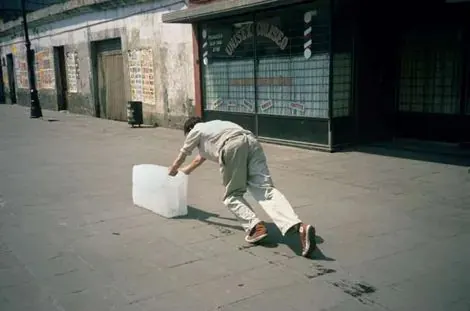
Snapshot of Paradox of Praxis I
(Sometimes Making Something Leads to Nothing).
Photo credit: © Francis Alÿs
"Nine hours. What a waste of time!" one audience member yawned. Against him was Alÿs, dripping with sweat, kicking the ice cube with absolute frustration.
The art world appears to be composed of all the eccentric ideas and people — from Duchamp exhibited a urinal fountain to Maurizio Cattelan's $120,000 duct-taped banana artwork. With the exaggeration of the media, art seems to be "crazy people doing crazy things".
In this article, we would like to introduce you to three TED Talks to initiate a discussion on art, so you can probably start to understand its relevance, its variety, its urgency and even its absurdity.
Why the Live Arts Matter?
Ben Cameron
Technological development signals creativity and flexibility. Nowadays, you can watch a concert or opera with a flick of fingers anytime and anywhere. Technology has led to a more democratic system in many industries. For example, young people passionate about making movies do not need to spend decades working for a company to produce a movie. Now, they can start filming right away with their phones.
In this TED Talk, Cameron addresses why art and the experience of live art are ever more urgent in such digital time. From community development to art activism, Cameron stresses upon the social importance of art — "The arts, whatever they do, whenever they call us together, invite us to look at our fellow human being with generosity and curiosity."
How art gives shape to cultural change?
Thelma Golden
As the curator and director of the Studio Museum in New York City, Thelma Golden considers museum as "a think tank" and exhibition as "the ultimate white paper -- asking questions, providing the space to look and to think about answers." With decades of experience in exhibition curating, Thelma believes exhibitions can be a site of communication for local and international communities to rethink themselves and to image the possible futures together.
Reserving 18 minutes for yourself
Chiang Hsun
I, be the Rhododendron flowers that embrace the mountains
For spring of no regrets
I, be the stars
Devoted for the summer nights
…
I, be the moon
Full and illuminated, for you once again
If you be the island
I, be the ocean that embraces you
…
This TED talk begins with a poem titled Hope written by contemporary poet and author Chiang Hsun. One would be surprised by his question, when he, a practising poet with decades of years in writing and reading poems, asked, "I don't know what role poetry plays in this world." Indeed, poems can be vulnerable in reality because they can't resolve wars, famine or hatred.
In the early histories, poems are not written in words or meant to be read. They were meant to be listened to and sung with instruments. Poems are not only created for meanings, but also for conveying the texture of sounds. In this 18-min talk, Chiang proposes whether we can save 18 minutes, every day, every year, or maybe just once in our lives, for a poem, so you can feel the vibration of poems, with their comoentimentseaching and resonating with your soul.
In this 18-min talk, Chiang proposes whether we can save 18 minutes, every day, every year, or maybe just once in our lives, for a poem, so you can feel the vibration of poems, with their sentiments, reaching and resonating with your soul.
Author : Lenette Lua(TEDxGuangzhou Content team)
Editor : Jimmy Tan
Typeset : Phoebe Zhai
Proofread : Jimmy Tan