[Speakers Intro] Stop asking , let's take action right now.
First published 2 August 2016
▍On August 13th, the 2016 TEDxXiguan annual conference will be held, where 13 speakers will share their great ideas around the theme of “Constructive Disruption”. If you want to follow us, please scan the OR code to buy tickets.
The advent of Wikipedia has made carrying and referring to traditional encyclopedias much easier. Wikipedia also allows users to edit almost any article online, thus gradually makes it a free, justic and neutral platform for people to access to knowledge. It is, of no doubt, a classic example in social innovation, but it is not the only one. On TEDxXiguan Annual Conference, Jane Lee, Alisa Tsao and Yanjun Cai is are ready to share their views and experiences in this field.
From emerging of an idea to implement of a project, and to the optimisation of the whole, they pay attention to the involvement of every individual in the community at each session, even the people who benefited from the project. During this process, they not only have the surroundings of relatively vulnerable groups improved, but also change the way people think and feel about it.
Speaker — Jane Lee

Our commonsense is that photography should be highly connected with one's vision. Practitoner Jane Lee and her team, however, believe the opposite. A project led by Lee's team proves that can vision impaired people not only take incredible photos, but also “appreciate” them.
“As the visual ability dysfunctioning, the rest of the sensory system like auditory and somatic sensation will be somehow enhanced. Through other sense organs to feel and experience, people can better integrate into society.” Based on this observation, Lee and her team decided to encourage people with visual impairment to take photo, which is the original aim of this project.
Instead of stopping at the present acchievement , the young team made an appeal to people to participate this project. This year, they organised wide range of activities for volunteers and vision impaired people, which includes workshops, outdoor photography and experience sharing, arousing public's empathy for the visually impaired people and more importantly, reversing the public stereotype about them. At present, the project has recruited volunteers from different countries such as UK and France. Lee hopes that people from different sectors in different regions can try using other sense organs to feel and explore the world from different angles.
Speaker — Alisa TSAO

Alisa TSAO, a social designer from Taiwan, devotes herself in changing the community with “Design Thinking”. She is now leading a project to design a better world for the elderly and encourgae young people to engage in social innovation. Through learning the past experience, it dawns on her that the nature of social innovation is destruction and reconstruction.
Through the cooperation with KAIWU, a social enterprise devoting to change society with design thinking, Alisa and her team develops the virtual community into a social design participation programme in real world. They are now active in Xiguan, Guangzhou. Apart from online discussion, she also organized a series of offline workshops and field researches, forging their ideas into actions with individuals from all walks of life. What is interesting is everyone who involved in the project has widen his horizen and changed outlook on life as well.
Due to the belief of “everyone is an expert of his own life” and “the power of crossover”, Alisa always acts as a listener and communicator. She collects the ideas when seeking people in need, and organizes them into an efficient way of implementing. Also, she unveils the design procedure through the social media such as Wechat, engaging more people into it.
Speaker — Yanjun CAI
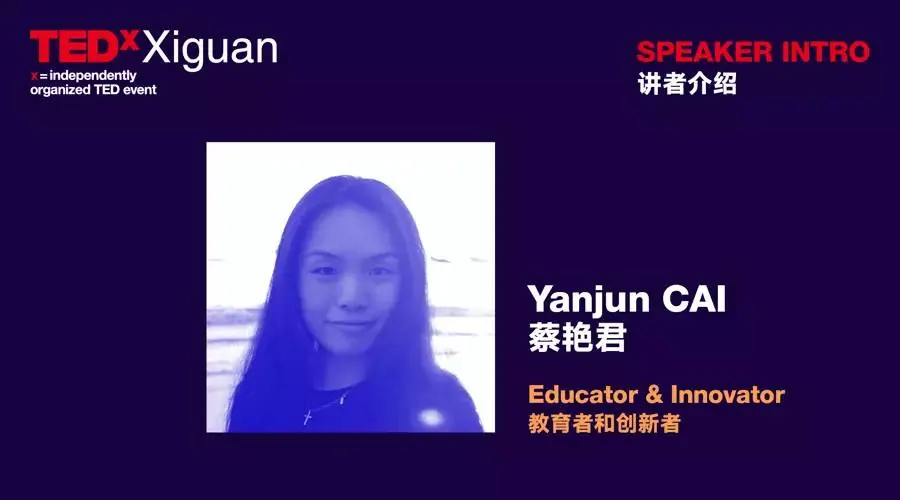
Nowadays, a growing number of people are facing and tackling disasters. As a lecturer of University of Albany, for one thing, Cai focuses on community development and community- resilience improvement through creative ways, for another, she also maintains cooperation with the UN Development Program and the Asian Development Bank.
Apart from her identity as a scholar, interested in diving, gym and dancing, she is also a warrior who obesssed with self-challenge. Extensive interest not only makes her have an all-round development, but provides unexpected ideas for her researches as well.
Two years ago, when she was in Philippine, she left her smartphone to the locals who are excluded from the municipal infrastructure system. Through simple learning, then, the local posted the pictures online telling the truth of the shanty town to the whole world, which illustrates that the vulnerable group, among the social context, can show their creativity and adaptability when coping with problems like foods and clothing, environment and development. Moreover, it encourages her to look for new approaches for post-disaster reconstruction.
Questioning is the beginning of solution.
Thinking is the engine of innovation.
After reading the introduction of the speakers above, may you have questions like:
“What is social innovation?”
“ Why should people engagae in it?”
“What's the difference between social innovation and social welfare?”
Please keep your questions in mind and bring them to TEDxXiguan 2016 annual conference, you will find the answer.
Writer / 黄绮靖
Translator / 秋韵 Cheryl
proofreader / Awen
Designer / Gwangjun.com