[Speakers Intro - Ben Wood & Barry Wilson] The City Of Tomorrow
First published 5 August 2016
▍On August 13th, the 2016 TEDxXiguan annual conference will be held, where 13 speakers will share their great ideas around the theme of “Constructive Disruption”. Scan the QR code to buy tickets and follow us.
Cities do not only serve as hubs for people's life, they also represent a living museum of what societies have achieved and how they think about their present and their future. Metropolis like New York, London and Shanghai have all unique characteristics not only because of their citizens but also because of the architecture of their buildings and public spaces. Benjamin Wood and Barry Wilson are two architects that have been focused on understanding the true nature of cities and how they can have a positive impact on people. Each one has a different approach and a different story, but they both share the same passion for ideas and constructive disruption.
Speaker — Benjamin T. Wood
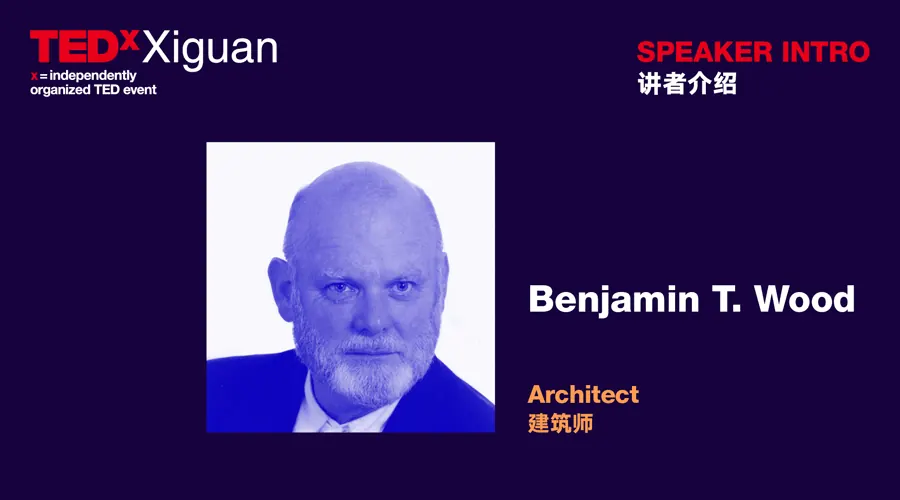
Benjamin Wood came to China in 1998 for a competition. The challenge was to build a neighborhood in Shanghai in one year. Wood got the job by proposing to construct the group of houses not by destroying what was already built, but by designing the new buildings around them. Since then, Benjamin Wood, who before becoming an architect also served as a jet pilot, has become one of the most reknown architects in the World and is now based in Shanghai.
Wood's work is focused in one thing: “create places, mostly outdoors, where people meet.” Before designing some of the most important buildings in China, Wood also worked making plans for redesigning emblematic American spaces, like Times Square in New York and the Art Deco District in Miami Beach. In China, where construction is booming, Woods found an opportunity to continue with his passion in a place where it was most needed.
One of the most important designs of Woods in China is the Xintiandi project in Shanghai. The 200 million-dollar complex changed Shanghai's look and was also a pivotal moment for Wood's career. Xintiandi is now visited by more than 15 million people each year and its model has been replicated in other cities in China. Woods believes that the success of the project relies on the quality outdoor space between buildings, in how public life exists and is fostered by architecture.
Xintiandi might be the first public space after the cultural revolution in China, and it's a symbol of how Chinese way of life has changed since then. Woods has tried to preserve the Chinese identity in a time where skyscrapers have become the rule across the biggest cities in China. His plan for the future seems intact: enable architecture to be part of the public life of people.
Speaker — Barry Wilson
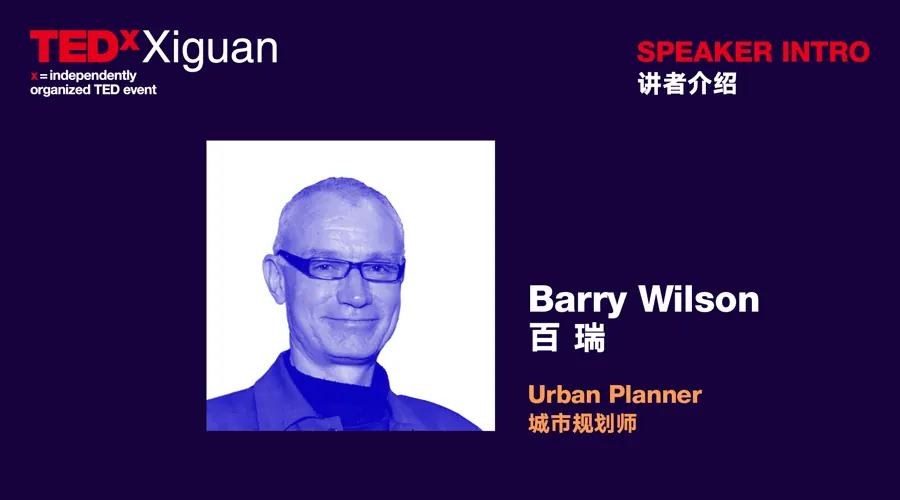
Science fiction has always served as a guide for real science. Writers and film makers have already imagined how life will be in the next centuries, and one key element in these fiction worlds is the city of the future.
Barry Wilson, the director of Barry Wilson Project Initiatives, has over 25 years of experience designing a large range of projects with a focus on creating sustainable design solutions that can help to re-imagine the city of the future, inspired by the images that science fiction has given us.
Based in Hong Kong, Wilson has served different roles advising and teaching in different organizations, and his ideas have been focused in the big problems of the future: climate change, access to water and safety, among others. Today, Barry Wilson is thinking on how to use the technology that we have available today to shape our lives in the changing world of tomorrow.
One of these ideas is a world with self-driving vehicles. From the experiences of Google's self-driving cars, the plans of Tesla and the announcements that Singapore will be the first country to release this technology widely, Wilson believes that it can solve many of the problems we are facing, like having fewer accidents and using more efficiently public space. He thinks that we should learn to cope with the uncertainty of a future and try to shape its nature to solve our most urgent needs.
Ultimately, the question that Barry Wilson wants to answer is how are they going to be the cities of tomorrow. For him, the only way to know is to let our imagination wander and be inspired by science fiction, but at the same time, it's important to remain focused on trying the real problems that we are facing as a society.
The Xintiandi project by Benjamin Wood and the ideas for the cities of tomorrow of Barry Wilson come from unexpected places. They are examples of how rules and dogmas need to be forgotten in order to create what people really need and to challenge our own limits. Constructive disruption is about that: thinking outside the box for coming with new ideas to problems that we haven't seen before.
Writer / Luis
Translator / 秋韵
Designer / Gwangjun.com